
Confirm a Camarillo Resident Search
Every fact needs its own proof. Ownership, a court appearance, a vital event, a business affiliation, a professional credential, and a historical address all sit with different custodians in Ventura County and beyond. The record type also decides what comes back: a public index, an informational copy, an authorized certified copy, or a restricted record. So start any Camarillo resident search with one question. What exactly needs proving? Then match each name result to its source, which keeps the lookup from being stretched beyond what the record says.
| Record | What it confirms | Where | Access and limit |
|---|---|---|---|
| Assessor or parcel | Assessed owner, situs, APN, mailing clue | Ventura Assessor and GIS | Owner is not necessarily an occupant |
| Recorded instrument | Named party and property transaction at a date | Ventura Recorder | Index first; underlying copy matters |
| Court case | Party role, case, filing date, events | Ventura Case Inquiry | Sealed and protected material excluded |
| Vital record | Birth, death, marriage, or divorce event | Ventura Clerk-Recorder or CDPH | Authorized and informational rules differ |
| Business or license | Entity, credential, status, public address | California SOS or DCA | Affiliation or office address is not residence |
| Unclaimed property | Historical name, city, holder clue | State Controller | May be stale; not present-residence proof |
Keep the source date and stable number with each hit. A bare full name is only a lead. Middle initials, a city, a role, or a date give it weight. The California State Controller unclaimed-property search can add a historical name and city clue. It may reflect an old address, though. So treat it as a pointer rather than present-residence proof.
Build a Camarillo Identity Worksheet
Same-name collisions are the main hazard here. A Camarillo resident lookup survives them with discipline. Start with the spelling supplied, then test former surnames, initials, diacritical and ASCII variants, and likely word order without declaring them equivalent. Add one anchor, like an age range. A parcel, case number, entity number, or license number all count, and for each result you should log the custodian, record role, event date, address type, and stable identifier.
- Write the name exactly as known and set a time window.
- Find one independent anchor, such as a parcel APN, court case, entity number, or license number.
- Compare the role and date across two custodians instead of matching a name alone.
- Separate a situs, mailing, office, agent, attorney, or return address from a residence claim.
- Mark conflicting or unresolved matches as unresolved and correct the source with its custodian.
Clerks are not fact-finders. Ask a clerk for procedure. Never ask the office to decide whether two records describe one person. Make the comparison yourself from the permitted record fields, which keeps a Camarillo resident lookup grounded in evidence rather than assumption.
Camarillo Court Name Checks
Ventura Superior Court handles Camarillo's civil, criminal, family, and probate matters. Case Inquiry offers a name or case-number path. Coverage differs by division, though. Family Law entries begin September 1, 1991, with some older active matters included, while former Municipal Court criminal and traffic entries begin January 1, 1989, and felony coverage expanded after the courts combined in 1995. A pre-1995 absence is not a final answer.
| Case number | Most precise search key when the full court format is known. |
|---|---|
| Party name | Alternative search path; try variants and confirm the role. |
| Case type or division | Separates civil, criminal, family, probate, and other workflows. |
| Date range | Optional or category-dependent narrowing control where exposed. |
A case result can show the case number, caption, category, filing date, and register events. It may also list the assigned department or judicial officer. Filed documents are not all public online. The court's records department handles many paper files. Probate and juvenile records sit in special locations with their own restrictions. Copy charges are published. They include $0.50 per page, $40 certification, and $1 per page for comparison. A search beyond ten minutes costs $15. Exemplification runs $50. Mail requests take the court form, case detail, payment, and a stamped envelope.
Ventura Superior Court Case Inquiry is the starting index. Use the court records instructions when you need a file or a certified copy.
Camarillo Business and License Records
A business or professional record can separate people who share a name. It proves affiliation, though, not residence. The California Secretary of State's bizfile Online searches an entity name or file number. Advanced filters can narrow entity type, status, filing date, or begins-with behavior. Results may show the legal name, entity number, status, formation jurisdiction and date, principal or mailing address, agent, managers or officers where filed, and Statement of Information dates. Filing history and document images may appear too.
Ventura County's fictitious-business-name channel and Camarillo business-tax records add local name use. A DBA is not a license. Neither is a business-tax certificate. An agent's address may just be an office. Match entity or filing numbers and dates. That is the safest test before treating two business results as the same affiliation.
| DCA field | Type | What it can narrow |
|---|---|---|
| Board or bureau | Dropdown | Relevant licensing authority |
| License type or number | Dropdown or text | Credential category or precise record |
| Business, first, or last name | Text | Name or organization search |
| City or county | Multi-select or text | Geographic narrowing, up to ten selections |
| Status or discipline filter | Dropdown or filter | Current status and public action records |
Both routes are free. Use bizfile Online for entities and the California DCA License Search for credentials, while board-specific sites remain authoritative for the field they control.
Camarillo Vital Record Access
Ventura County holdings run from 1873 to the present. CDPH-Vital Records keeps the statewide birth, death, fetal-death or stillbirth, marriage, and divorce data. California has no single fixed-year genealogy release rule. Health and Safety Code sections 103525-103526 separate authorized certified copies from informational certified copies. Family Code section 511 restricts confidential marriage records.
The current CDPH vital-record forms ask for record type, number of copies, names, event date and place, requester relationship, entitlement category, signature, and payment. Mailed authorized copies generally need notarization as instructed. The fee is a search fee. It applies even when no record is found. CDPH can issue a Certificate of No Public Record. The 2026 fee schedule reflects AB 64, which also allows diacritical marks on covered certificates.
Historical clues can come from several places. FamilySearch, Ancestry Library, newspapers, church registers, cemetery records, and the California State Archives are all options. Treat an index as a lead. A divorce certificate is not the court file or judgment. Adoption and original birth records follow separate confidentiality and court routes.
| Birth | 2026 CDPH fee $31; authorized and informational products differ. |
|---|---|
| Death | 2026 CDPH fee $26; historical indexes may guide, but a certificate is the custodian record. |
| Public marriage | 2026 CDPH fee $19; use the appropriate county or state form. |
| Divorce certificate | 2026 CDPH fee $18; court pleadings and judgment are separate. |
Camarillo Heir and Classmate Searches
Different questions send you to different records. An heir search starts with a decedent. It works toward a Ventura probate petition, the notices, and the estate file. A classmate search is friendlier territory. It pairs a school with a graduation window. Then it leans on yearbooks, newspapers, and reunion material. A birth-parent search is different again. It runs on lawful consent and state programs, never on an open name directory. California's CDSS Mutual Consent Program uses AD 902 and related forms once both eligible parties agree. The agency itself cannot solicit consent or act as a public search service.
Local help exists. The Camarillo Library can help. The Ventura County Genealogical Society can too. Both can steer you through yearbooks, family histories, local books, and newspaper collections. PVHS Dons and Doñas biographies and scrapbooks document more than 500 long-serving residents. All were honored since 1964. Treat that collection as a community-history lead, not a current Camarillo resident lookup.
Keep notes as you go. For an heir, write down the decedent, case number, petition, notice, and each named role. For a classmate, pin the school and year before comparing names. For a birth parent, follow the consent or court procedure. A protected person may simply not be visible.
Camarillo Custody Record Limits
Some public interfaces identify a person through custody or registration status, and each one must be read narrowly. Ventura County Sheriff inmate information covers current county custody. CDCR CIRIS covers state-incarcerated records. It updates daily. California Megan's Law exposes only legally disclosable registrant information, behind a statutory warning. Read results with care. A booking entry is not a conviction. A parole-eligible month is not necessarily a release date. A similar name still needs age and other matching facts before it means anything.
Ventura Sheriff inmate information and CDCR CIRIS are the local and state routes for custody records. Megan's Law runs on its own warning and search path. For disposition, go to the relevant court record. Never republish protected details.
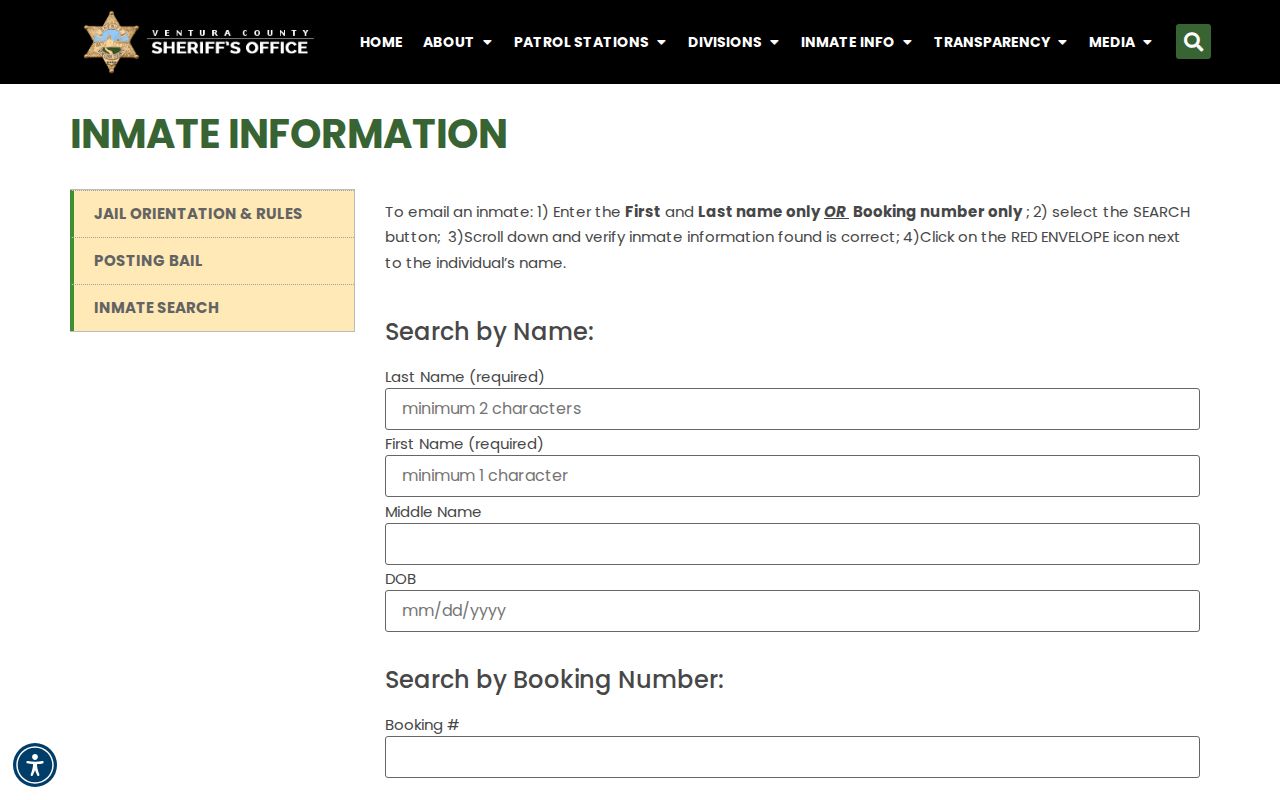
A county custody resource is one narrow slice of a Camarillo resident lookup, not a general directory. California Megan's Law supplies the state registry route.
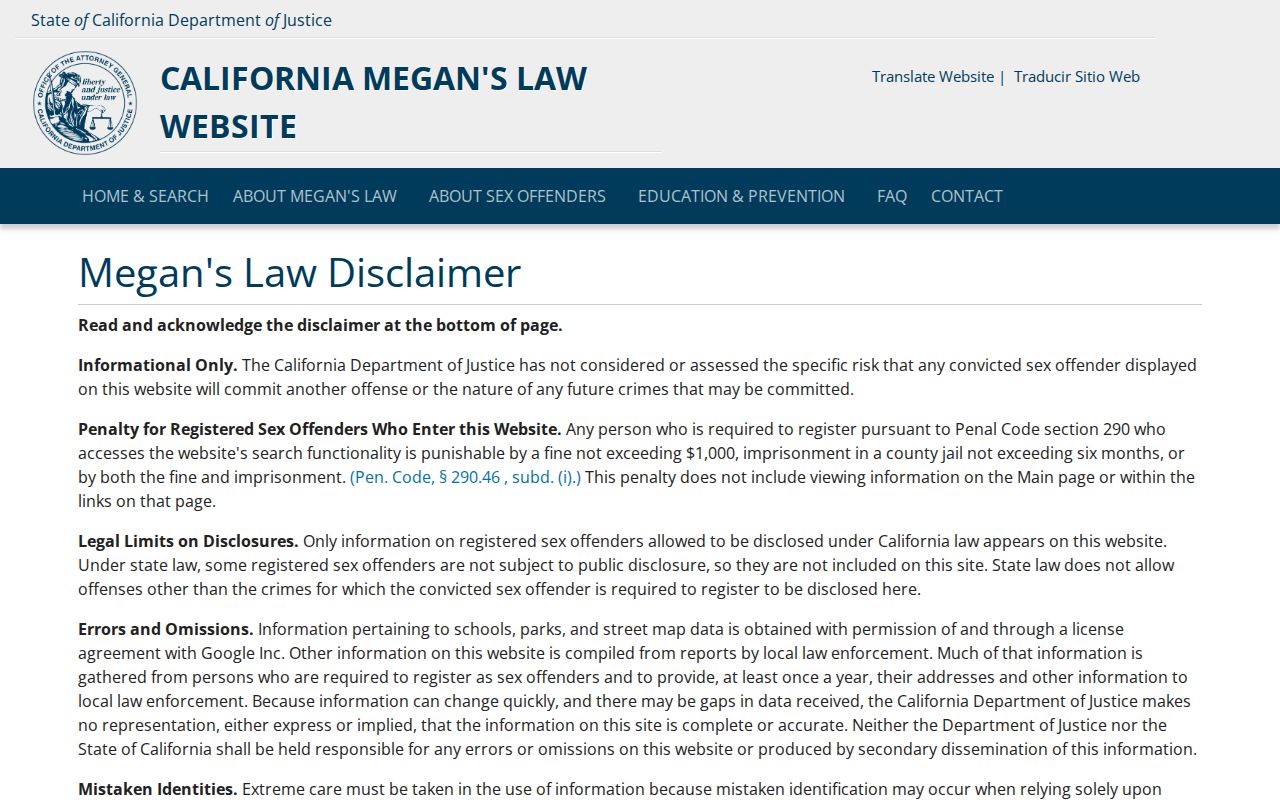
The state registry’s legal-use warning matters as much as its search controls.
Correcting Camarillo Resident Records
A wrong entry in a Camarillo record has a fix. Contact the custodian who holds it. Bring the record number, the result date, a screenshot, and any document that backs the correction. Courts can seal qualifying material by order. The Recorder keeps the official instrument intact while certain identifiers get special handling. Government Code section 7924.000 shields voter addresses, signatures, and identifiers, and Safe at Home gives eligible participants a substitute address.
The California Public Records Act, starting at Government Code section 7920.000, works as a fallback for an existing, identifiable, nonexempt city or county record. Name the department, the subject, an address or APN, a date range, and the format you want. An agency does not have to build a new resident list or do research for you. A qualifying voter-file purpose calls for the state voter-file application plus its access rules, not a casual reverse search. When an online index stops short, the counter, a mail form, the library, the archives, or a narrow CPRA request still open doors.
Lawful personal use. A Camarillo resident lookup is appropriate for family history, respectful reconnection, estate research, or civic inquiry. Do not use records to stalk, harass, threaten, intimidate, or expose a protected person.
Limits on a Camarillo Resident Lookup
Commercial compilations grow stale. They merge same-name people into one phantom record. No removal process can erase a deed held by a government custodian. The same goes for a court case. The same goes for a license or vital record. California DROP can route a consumer deletion request to more than 500 registered data brokers. It is a privacy tool, though. It is not a public-record correction.
A reliable Camarillo resident lookup ends with a source note. State what the record is and who holds it. State what date it covers and what it does not show. Note where a certified copy lives. If the name-to-address question becomes a whole-street question, switch to the address workflow. If it turns historical, use the city directory collections and mind their edition limits.